
Best Dropshipping Apps for Shopify in 2026: 15 Options Compared
No single app suits every store. This guide compares 15 Shopify dropshipping apps by price, free-plan limits, shipping speed, and per-order cost. It also flags the billing, supplier, and import-duty problems merchants report most.

Oct 18, 2026 · 18 min read
Quick answer: no single app is best for every store. Choose based on where you source products and where your customers live:
Start at $0 with AliExpress products: DSers (free Basic plan)
Free, with more warehouse options: CJdropshipping
Faster delivery to US and Canada customers: Zendrop, DropCommerce or Spocket
Fashion stores: Trendsi or Eprolo
Custom or branded products: Printful or Printify
Heavy automation at scale: AutoDS (often paired with DSers)
Zero-fee partnerships with other Shopify brands: Shopify Collective
Dropshipping guides often disagree on prices and ratings, and many simply repeat each app’s marketing page. This guide covers 15 options, shows what each plan adds to the cost of every order, explains what “free” includes, and flags the billing and supplier problems merchants report most.
How this guide was researched
Figures come from official pricing pages, Shopify App Store listings and recent merchant reviews checked between May and October 2026. No test orders were placed for this article, so delivery times are the ranges that apps and independent reviewers report, not our own measurements. Where sources disagree, you’ll see a range or a note. Ratings are approximate snapshots and drift over time. Where we say reviewers or merchants “report” a problem, we mean complaints in the merchant reviews described above, such as those on the Shopify App Store. They are not our own testing, so check the current reviews before you decide.
The best Shopify dropshipping apps at a glance
App | Best for | Cost to start | Typical delivery | Shopify rating (approx.) |
|---|---|---|---|---|
DSers | AliExpress orders in bulk | Free; paid from $19.90/mo | 1–4 weeks from China | about 4.9 (5,000+ reviews) |
CJdropshipping | Free sourcing, many warehouses | Free; memberships from $15.99/mo | 3–8 days (US stock), 10–20+ days (China) | 4.9 (2,500+) |
AutoDS | Automation and monitoring | From $26.90/mo | Depends on supplier | 4.5 (1,200+) |
Zopi | AliExpress/Temu importing | Free; paid from $19.90/mo | Depends on supplier | 4.4 (270+) |
Zendrop | Beginners wanting US shipping | Free; Pro $49/mo | 5–8 days (US stock) | 4.5 (1,100+) |
Spocket | US/EU suppliers | From $39.99/mo (trial, no free plan) | 2–8 days domestic | about 4.0 (580+) |
DropCommerce | US/Canada vetted suppliers | Free to browse; paid from $29/mo | 2–7 days | 4.6 (about 110) |
Syncee | Wide global supplier catalog | Free (25 products); paid plans extra | Depends on supplier | 4.1–4.3 (about 500) |
Trendsi | Fashion and apparel | Free; Pro about $29.90/mo | 2–7 days (US) | about 4.9 |
Eprolo | Free fashion and POD sourcing | Free plan | Depends on warehouse | Not listed |
Printful | Premium print on demand | Free; Growth $24.99/mo | About 5–10 days | 4.8 (3,600+) |
Printify | Cheaper print on demand | Free; Premium $39/mo ($24.99 billed yearly) | About 5–10 days | about 4.7 |
Shopify Collective | Selling other Shopify brands’ products | Free | Set by each supplier | Not applicable |
Importify / Product Upload | Importing from any product URL | $9.99–$14.95/mo | Depends on supplier | 4.4–4.6 (small review counts) |
Modalyst | Brand-name suppliers (use caution) | Free to install | Varies | 2.5 (37 reviews) |
How to choose a dropshipping app (five questions)
Where are your customers? Delivery time is the biggest conversion lever. Customers in the US, Canada or EU usually expect days, not weeks.
What can your margins absorb? US and EU suppliers cost more per unit than AliExpress. A cheap app on a thin-margin product still loses money.
How much do you want automated? Basic apps forward orders. Advanced ones also monitor supplier prices and stock.
Do you want to build a brand? Branded packaging, invoices and private labeling usually need a paid plan, and sometimes a minimum order.
What happens when something goes wrong? Check support channels, refund policies and how the app handles out-of-stock items before you scale.
You can use more than one app, but avoid paying for two apps that do the same job.
The 15 best dropshipping apps for Shopify in 2026
Each review covers who the app suits, what it costs, what to watch for and a short verdict.
AliExpress and China-sourcing apps
1. DSers: best free option for AliExpress dropshipping

Best for: new stores and high-volume AliExpress sellers. Pricing: Basic is free (3,000 products, 3 stores, bulk ordering). Advanced is $19.90/mo, Pro is $49.90/mo, Enterprise starts at $499/mo. Advanced and Pro include a 14-day trial.
DSers is AliExpress’s official dropshipping partner and the successor to Shopify’s old Oberlo. Its strength is processing many orders at once, mapping products to suppliers, and finding alternative suppliers when one runs out. Paid plans add automatic pricing rules, bundles, and faster updates.
Watch out for: delivery from China often takes weeks, and DSers can’t change that. Some reviewers report sync problems around variants and shipping rates, and others mention add-on charges that weren’t obvious before upgrading.
Verdict: the default starting point if you’re sourcing from AliExpress.
2. CJdropshipping: best free sourcing platform with global warehouses

Best for: testing products at no monthly cost.
Pricing: free to use. Optional memberships are Plus $15.99, Prime $19.99 and Advanced $59.99 per month. The free plan includes five daily sourcing requests and unlimited listings. Your real costs are product, shipping and any packaging or 3PL fees.
CJ runs more than ten warehouses, including the US and Europe, and offers quality checks, custom packaging, print-on-demand, and custom product sourcing. Products stocked locally can arrive in roughly 3–8 days, while China-warehouse items often take 10–20+ days.
Watch out for: reviewers report processing delays, inconsistent support depending on the agent, and stock-outs flagged after an order is placed. The Shopify listing is rated highly, but some other review platforms are much lower.
Bottom line: a strong free option, best when you choose items stocked in a nearby warehouse.
3. AutoDS: best for automation and price/stock monitoring
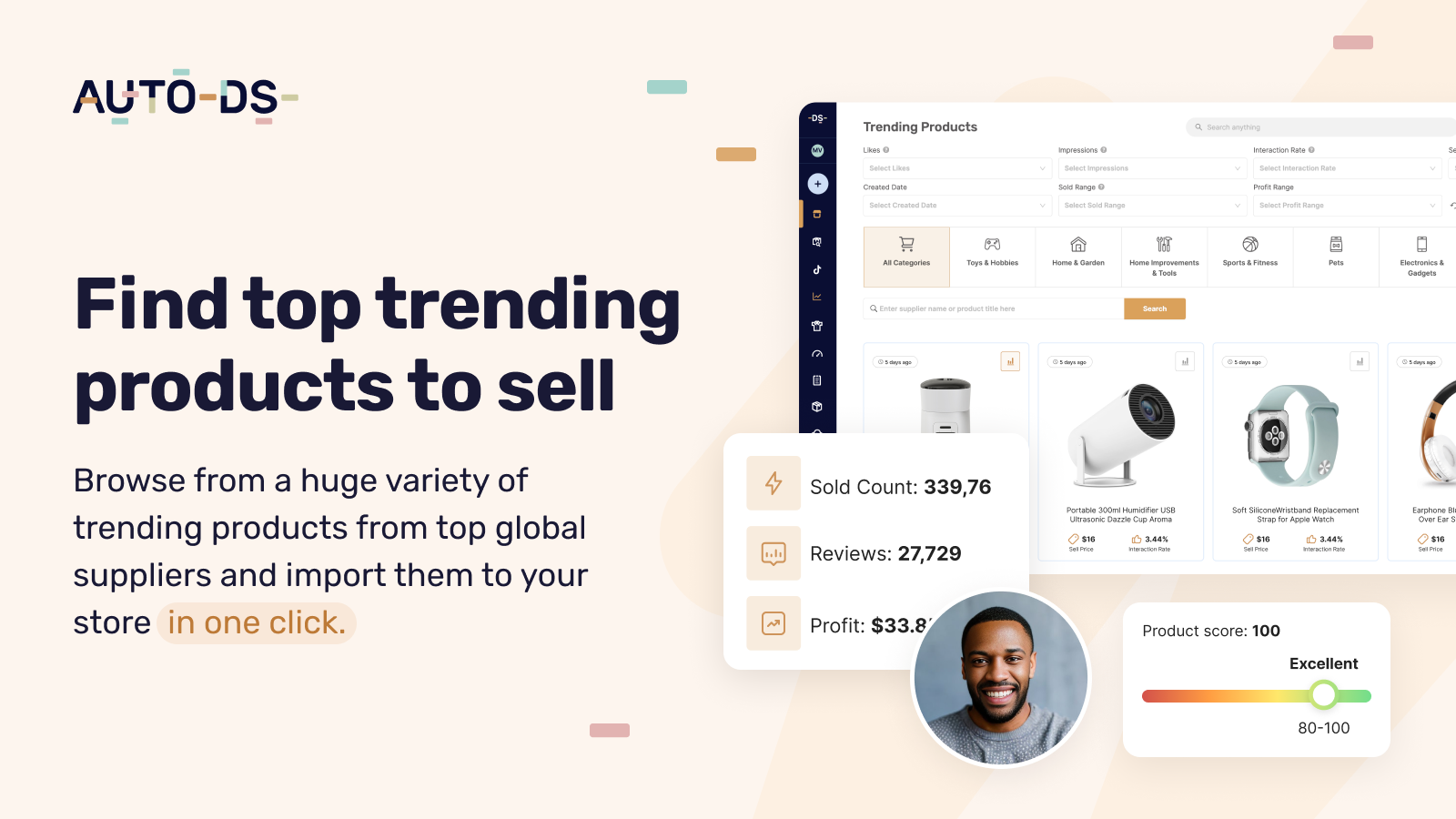
Best for: stores with many products that outgrow manual work.
Pricing (Shopify): Import 200 is $26.90/mo, Starter 500 is $39.90/mo, and Advanced 1K is about $67–70/mo depending on the source. Recent sources describe a paid $0.99 three-day trial rather than a free one.
AutoDS connects to 25+ supplier sources and automates imports, repricing, stock monitoring and order fulfillment. Its monitoring protects you from two costly mistakes: selling out-of-stock items and selling below cost after a supplier raises prices.
Watch out for: plan limits count product variants, not products. A shirt with three colors and three sizes uses nine slots, so the 200-variant plan fills faster than expected. The entry plan has no price or stock monitoring, and the interface has a learning curve.
Worth it if: manual order handling eats hours of your week.
4. Zopi: AliExpress and Temu importing with AI credits

Best for: merchants importing from AliExpress, Temu, and CJ who want a simpler app.
Pricing: free (20 published products, 15 fulfilled orders, 10 AI credits), Launch $19.90/mo, Scale $49.90/mo, Expand $199.90/mo.
Zopi imports products, updates prices and inventory, and tracks shipments. It’s rated about 4.4 from roughly 270 reviews.
Watch out for: the free plan runs out quickly, and some recent reviewers say features have declined. Its review base is small.
US, EU, and Canada supplier apps (faster shipping)
5. Zendrop: best for beginners who want US shipping

Best for: proven products that need faster delivery and branding.
Pricing: Free, Pro $49/mo, Plus $79/mo (about $399 and $549 per year). If you’re billed through Shopify, the tier follows how many products you link: roughly 21–100 for Pro and 101+ for Plus, so check your exact tier on Zendrop’s pricing page before upgrading. Trials are 7 days on direct billing and 3 days through Shopify.
Zendrop offers access to 1M+ products, US warehouses with typical delivery around 5–8 days, product sourcing requests, AI features and an academy. Private labeling and custom packaging may require minimum order quantities.
Watch out for: the free plan doesn’t include automated fulfillment, upgrade prompts are frequent, support is reported as slower and email-based, and the catalog is narrower than open marketplaces.
Best next step: upgrade once a product is selling and delivery speed starts to matter.
6. Spocket: best for vetted US and EU suppliers

Best for: stores selling to the US or Europe that care about product quality.
Pricing: Starter $39.99, Pro $59.99, Empire $99.99, Unicorn $299.99 per month. Billed yearly, Pro drops to about $24/mo, Empire to about $57 and Unicorn to about $79. There is no free plan.
Spocket lets you order samples, offers branded invoicing on higher plans, and favors US and EU suppliers for shorter delivery. Money-saving tip: Pro billed yearly is cheaper than Starter billed monthly and allows far more products.
Watch out for: product costs are higher than AliExpress. Merchants frequently report being charged after a trial ended, and the trial length shown on the site has been inconsistent (7 vs 14 days). Set a calendar reminder and cancel early if you’re unsure.
Verdict: a good quality-focused choice, but read the billing terms carefully.
7. DropCommerce: best for US and Canadian suppliers

Best for: stores that sell trust and speed to North American customers.
Pricing: free to browse suppliers and order samples. Basic $29/mo (about 25 products), Growth $55/mo (250 products, branded invoicing), Pro $95/mo (unlimited products, automated fulfillment). Paid plans offer a 14-day trial, and a higher-priced plan above Pro also exists.
Suppliers are hand-picked and can be filtered by values such as made in the US, eco-friendly, handmade, or women-owned. Delivery is typically 2–7 days.
Watch out for: margins are modest because US and Canadian goods cost more, the app is English-only, and a few reviewers report sync inconsistencies and out-of-stock orders. It has a smaller review base (about 110).
Bottom line: a strong fit for a brand-style store in North America.
8. Syncee: best for a wide global supplier catalog

Best for: merchants who want suppliers in the US, Canada, UK, EU, Australia, and India, or who want to bring their own supplier data feeds.
Pricing: free plan with 25 products. Paid plans (Basic, Pro, Business) start at roughly $30–$40/mo depending on the source and promotions, with a short paid trial offer on the Shopify listing.
Syncee offers 8M+ products, an AI agent for product discovery, Alibaba.com integration, and a DataFeed Manager for your own suppliers. Plan limits count products, not variants. Automatic stock sync is a paid feature.
Watch out for: billing complaints after trials, and suppliers can leave the platform, which can strand products you’ve already listed.
Tip: test a few suppliers before you build a catalog around them.
Fashion and apparel apps
9. Trendsi: best for fashion dropshipping
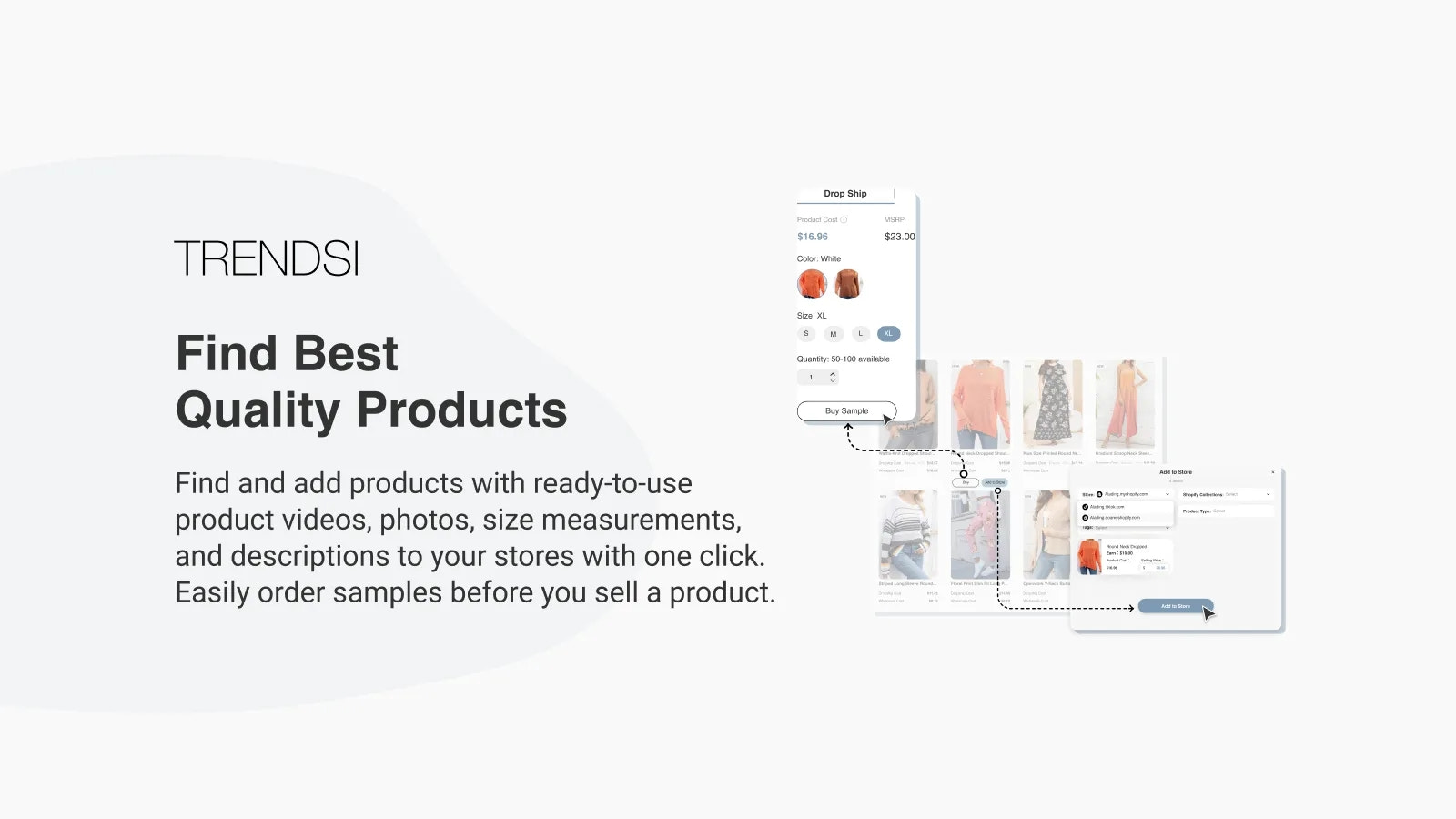
Best for: clothing, accessories, and beauty.
Pricing: free (up to 500 listings), Pro about $29.90/mo with unlimited listings and bulk import.
Trendsi ships from California, typically in 2–7 days, and supplies photo-ready listings and branding options. Its Shopify rating is about 4.9.
Watch out for: the catalog is fashion-focused, return rules vary by item, and trending items can sell out around launches.
Verdict: the first app to try if you sell apparel in the US.
10. Eprolo: best free option for fashion and print on demand

Best for: budget-conscious fashion sellers.
Pricing: free plan; paid options add features and branding.
Eprolo promotes weekly new fashion styles, a 7-day return policy for fashion items, a Chrome importer, AI-assisted sourcing, print-on-demand, and third-party logistics in multiple locations. Branding options apply to the fashion category.
Watch out for: free-plan limits and category-specific features. Test with samples before scaling.
Print-on-demand apps
11. Printful: best for premium custom products

Best for: brands, creators and designers.
Pricing: free to use; optional Growth plan $24.99/mo (up to 33% off products), which Printful makes free for a year once you reach $12,000 in yearly sales.
Printful runs its own production and offers 500+ products, mockups, branded labels and inserts, and fulfillment across several regions. Its rating is about 4.8.
Watch out for: higher base prices mean thinner margins, and support is chat and email.
Best when: quality and branding matter more than the lowest cost.
12. Printify: best for lower print-on-demand costs

Best for: sellers who want more choice and lower base prices.
Pricing: free (unlimited designs, up to five stores); Premium is $39/mo, or $24.99/mo billed yearly, with up to 20% off products. The monthly price rose from $29 to $39 in February 2026; the yearly rate did not change.
Printify connects you to a network of 85+ print providers, so you can choose by price, location or rating. Order routing can switch to a backup provider if your primary is unavailable.
Watch out for: quality varies by provider, and support is reported as chat-only. Printful and Printify announced a merger in November 2024 but continue to operate as separate brands.
Verdict: a strong value pick; order samples from your chosen provider first.
Other ways to source products
13. Shopify Collective: best zero-fee option for curated brand products
Best for: adding complementary products from other Shopify brands.
Pricing: free, built into Shopify as a sales channel, with no setup fee, monthly fee or Shopify commission. Standard payment processing fees still apply.
You import suppliers’ products, set your own prices, and pay the supplier only when something sells. The supplier ships the order.
Watch out for: eligibility depends on your plan, country, currency and Shopify Payments, and it has changed over time. Check the Collective app in your Shopify admin. Suppliers can disconnect, and reported margins vary widely.
Verdict: ideal for a curated store, less suited to high-volume “random” dropshipping.
14. Product importers (Importify, Product Upload): best for importing from any URL
Best for: sellers who source from many sites and handle fulfillment themselves. Pricing (vendor-reported): Importify from about $14.95/mo; Product Upload from $9.99/mo with a small free allowance.
These apps paste a product link into a Shopify listing with images, variants and prices, often with AI rewriting. They don’t forward orders to suppliers.
Watch out for: no inventory sync, small review counts, and legal risk. Dropshipping from Amazon listings can violate Amazon’s policy, and Temu or Shein items may involve trademark problems.
Best use: building listings, not running a full dropshipping system.
15. Modalyst: approach with caution

Modalyst was once a popular brand-name marketplace and is now part of Wix, but its Shopify listing showed a 2.5 rating from 37 reviews in 2026, with complaints that products appear available when they aren’t. If you try it, order samples and place test orders first.
Costs to plan for
The app subscription is only part of what an order costs you. Plan for free-plan limits, the fee each plan adds per order, and import duties.
How much each plan adds to every order
The subscription price matters most at low volume. Here is the monthly fee spread across orders:
App plan (monthly fee) | Per order at 20 orders/mo | At 100 orders/mo | At 500 orders/mo |
|---|---|---|---|
DSers Advanced ($19.90) | $1.00 | $0.20 | $0.04 |
AutoDS Starter 500 ($39.90) | $2.00 | $0.40 | $0.08 |
Printify Premium ($39) | $1.95 | $0.39 | $0.08 |
Zendrop Pro ($49) | $2.45 | $0.49 | $0.10 |
Spocket Pro ($59.99, billed monthly) | $3.00 | $0.60 | $0.12 |
DropCommerce Pro ($95) | $4.75 | $0.95 | $0.19 |
The app fee isn’t your highest cost. Here is an illustrative $30 order (assumed numbers, not quotes). Payment fees assume about 2.9% + $0.30, which depends on your Shopify plan, country, and payment provider. Neither example includes import duties (see the next section).
AliExpress-style supplier: $9 product + $3 shipping + $1.17 payment fee leaves about $16.83 before ads and fees.
US-warehouse supplier: $12 product + $5 shipping + $1.17 payment fee leaves about $11.83.
The US route earns about $5 less per order. It can still win if faster delivery lifts conversion or cuts refunds and chargebacks. Remember Shopify itself costs $39/mo on Basic ($29 on annual billing), plus ads and any extra apps.
Duties and tariffs on China-sourced orders
If you ship from China to US customers, check duties before you pick a supplier. The US ended its duty-free “de minimis” exemption for low-value packages from China and Hong Kong in May 2025, and for all countries on August 29, 2025. Duties now generally apply to these parcels, and the rates depend on the product and its origin and change often. CBP made the suspension indefinite in 2026; see the Federal Register notice.
When you price a product, add expected duties to the examples above. Ask each supplier whether its quoted shipping price includes duties (often called DDP, or delivered duty paid), and remember that duties paid on a returned item may not be refunded. If you sell to the EU, UK or another market, check that market’s import rules too.
Free plans: what you get
App | What’s free | The catch |
|---|---|---|
DSers | 3,000 products, 3 stores, bulk ordering | Pricing rules, bundles, and faster syncing need paid plans |
CJdropshipping | Free account, 5 daily sourcing requests, unlimited listings | You pay for product, shipping, and extras |
Zendrop | 1M+ product catalog | No automated fulfillment on free |
DropCommerce | Browse suppliers, order samples | Order processing needs a paid plan |
Syncee | 25 products | Automatic stock sync is paid |
Trendsi | Up to 500 listings | Fashion only; Pro unlocks bulk features |
Printful / Printify | Full platform | You pay per order; discounts need paid plans |
Shopify Collective | Free channel | Eligibility rules; suppliers can leave |
Spocket / AutoDS | No free plan (trial only) | Check trial and auto-renewal terms |
Billing and supplier red flags to check before you subscribe
Trial auto-conversion: several apps are reported to charge when a trial ends, sometimes earlier than expected. Note the end date and cancel inside the app if you’re unsure.
Variant vs product limits: AutoDS counts variants. Syncee counts products. Know which one applies.
Suppliers can disconnect: on marketplaces and on Collective, a supplier can leave and strand your listings.
Out-of-stock lag: apps with weak stock sync can sell items that are gone. Place test orders before running ads, and see how to hide out-of-stock variants in Shopify so customers can’t pick an option you can’t fulfill.
Trademark and platform rules: avoid counterfeit-branded products and check Amazon, Temu, and Shein terms if you source there. Products that violate Shopify Payments terms can’t be sold with Shopify Payments.
Support gaps: confirm chat or email availability, and who handles refunds when a supplier fails.
Best dropshipping app by situation
Zero budget, testing a niche: DSers Basic or CJdropshipping.
Selling to the US or Canada: Zendrop, DropCommerce, Trendsi (fashion), or CJ with US-stocked items.
Selling to the EU or UK: Spocket (US and EU suppliers), Syncee (UK and EU suppliers), CJ’s European warehouses, or Printful and Printify’s European production.
Selling to Australia or India: Syncee lists suppliers in both; check CJ and Printful for local fulfillment on your chosen items.
Building a brand: Printful or Printify, Zendrop’s branding features, or Shopify Collective partnerships.
Scaling past a few hundred orders: AutoDS for monitoring, often alongside DSers.
Running a store from a country where Shopify Payments isn’t available: your customers’ location still decides your supplier, but payments need separate planning. Check which gateways your country supports, expect a Shopify third-party transaction fee on top of the gateway’s own fees, and note that Collective requires Shopify Payments.
Apps that complement your dropshipping app
The supplier app is only half the stack. Most merchants also add:
Profit tracking: TrueProfit shows net profit after ads, fees, and product costs (from about $35/mo, with manual cost entry).
Reviews: Judge.me and Loox collect and display customer reviews.
Order tracking: AfterShip and ParcelWILL give customers branded tracking pages and reduce “where is my order?” tickets.
Email and SMS: abandoned-cart and post-purchase flows (for example, Omnisend or TxtCart) improve repeat sales.
Stock display matters too. When a supplier runs out of an item, your storefront should say so clearly. Shopify apps from Pluginos cover this, for example by hiding sold-out variants or sending back-in-stock alerts.
AI features in dropshipping apps (2026)
AI is now a selling point, but it’s uneven. Zendrop offers AI features and a store builder, AutoDS has AI-assisted product research, Syncee has an AI agent for product discovery, Zopi uses AI credits, and DSers gates AI product optimization on higher plans. Use AI for research and listing copy, but verify supplier quality yourself.
Frequently asked questions
What is the best dropshipping app for Shopify in 2026?
It depends on where you source products and where your customers live. The quick answer at the top of this guide matches each type of store to an app.
Which dropshipping app is best for beginners?
DSers (free Basic plan) or CJdropshipping (free to use) keep costs near zero while you test products. Move to Zendrop or DropCommerce once a product sells and delivery speed matters.
What are the best free dropshipping apps for Shopify?
DSers, CJdropshipping, Eprolo, Trendsi, Printful, Printify, and Shopify Collective all have free entry points. Free plans have limits, so check the free plans table above.
Does Shopify allow dropshipping?
Yes. You must still follow Shopify’s rules, your payment provider’s terms, and consumer laws, and you remain responsible for customer service.
Do I need an app to dropship on Shopify?
Technically no, but manual product imports and order placement become unmanageable beyond a handful of orders per week. An app automates imports, stock updates, and order forwarding.
Is Shopify dropshipping automated?
Partly. Apps can forward orders and sync tracking. Advanced apps also monitor prices and stock. You still handle marketing, supplier problems, and customer support.
Is Shopify dropshipping profitable in 2026?
It can be, but margins are thinner than they once were and depend on product cost, delivery speed, ad costs, duties and refunds. Branded or niche products usually hold margin better than generic ones.
Which Shopify plan is best for dropshipping?
Most new stores start on Basic ($39/mo, or $29/mo billed annually). Consider Grow when you need more staff accounts or lower card rates.
Which dropshipping app has the fastest shipping?
Apps with local stock: Trendsi and DropCommerce (about 2–7 days), Spocket for domestic US/EU orders, Zendrop (about 5–8 days), and CJ’s local warehouses. China-sourced items are typically slower.
Can I use more than one dropshipping app?
Yes. Many stores combine DSers for long-tail items with Zendrop or Spocket for proven sellers. Avoid listing the same product through two apps.
Final recommendation
Start small. Pick one app that matches your sourcing, run it on a free plan or trial, place two or three test orders to yourself, and measure real delivery times and support responses. Upgrade only when order volume justifies the fee, and re-check pricing before each renewal.
Written by
Pluginos
Pluginos is a WordPress, WooCommerce, and Shopify development team with 8+ years of experience building plugins, apps, and eCommerce solutions. We share practical tutorials and insights based on hands-on development experience.
Related articles
How to Show Tax-Included and Tax-Excluded Prices in Shopify
Help retail and business customers understand your pricing. Learn how to display VAT-inclusive and VAT-exclusive prices on Shopify product and collection pages with the Pluginos VAT Dual Prices app.
Oct 13, 2026 · 15 min read
Best Shopify App for Halloween Sales in 2026: 14 Apps Compared
Find the best Shopify app for Halloween sales with this practical comparison of 14 tools. Explore bundles, countdown timers, restock alerts, email campaigns, and seasonal effects, with pricing, plan limits, and tips to help you choose the right apps for your store.
Oct 13, 2026 · 17 min read
Best Shopify Wholesale Apps: Which One Fits Your B2B Store?
Compare the best Shopify wholesale apps for pricing, bulk ordering, buyer access, and payment terms. Explore features, costs, and plan limits to find the right solution
Oct 11, 2026 · 23 min read