
Best Shopify Apps for Small Clothing Stores in 2026
A practical guide to sizing, virtual try-on, returns, reviews, social selling, inventory, bundles, retention and specialist pricing tools.

Sep 23, 2026 · 16 min read
The best Shopify apps for small clothing stores solve problems that are already costing the business sales or time. For most apparel shops, the first useful additions are a size guide, product reviews and restock alerts. Add bundles, email automation, loyalty or advanced returns only when order volume makes the extra cost and complexity worthwhile.
How these apps were evaluated
Each app was assessed for clothing-specific usefulness, entry cost, free-plan availability, current Shopify App Store rating, likely setup burden and suitability for a small catalog or team. The comparison is intended for independent apparel stores, fashion boutiques and growing clothing brands. Product observations come from current listings, developer-provided screenshots and demos, and review patterns where reviews exist. They are not presented as hands-on tests. New apps with no reviews are clearly identified so readers can run a trial before relying on them.
Quick comparison
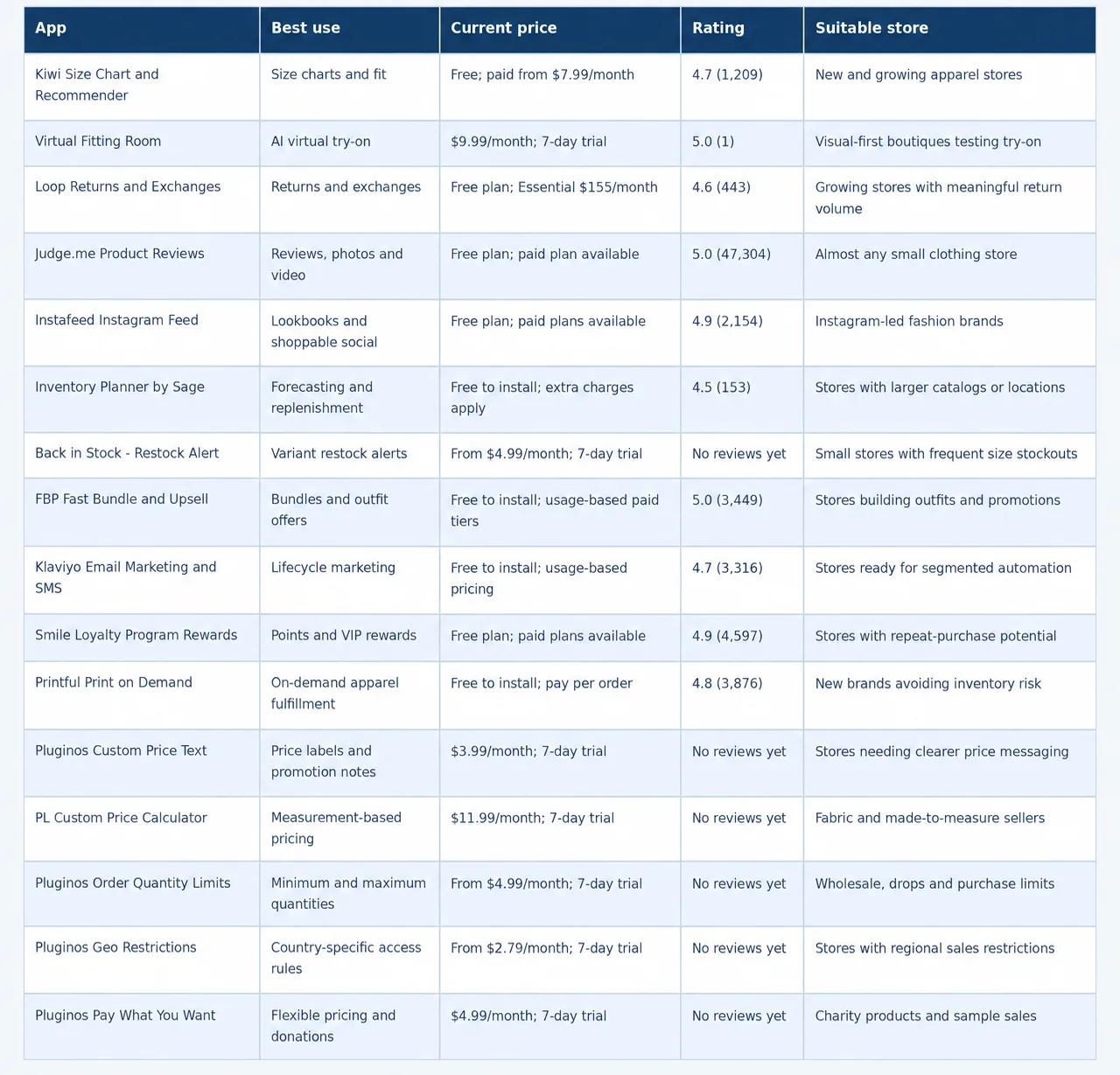
The best Shopify apps for small clothing stores
Size charts and fit recommendations
Best for merchants searching for a Shopify size chart app that reduces fit questions and size-related returns.
1. Kiwi Size Chart and Recommender
Best for size charts and fit recommendations

Official listing: View on Shopify App Store
Kiwi gives apparel merchants customizable size charts and AI-powered fit recommendations. The free plan allows up to three published charts, which can be enough for a small catalog with consistent sizing. Paid plans add more charts, analytics, translation and fit recommenders.
Price and rating: Free plan available. Premium starts at $7.99 per month; higher tiers may add order-volume charges. Rating: 4.7 from 1,209 reviews.
Advantages
Strong clothing-specific use case
Templates, unit conversion and CSV import
Free entry point for a small catalog
Disadvantages
The free plan includes Kiwi branding
Advanced recommendations require a higher plan
Merchants should review order-based charges before upgrading
Suitable store and evaluation: Best for new and growing apparel stores. Evaluation note: assessed from the current Shopify listing, feature descriptions, screenshots and merchant review patterns; not hands-on tested.
Virtual try on for clothing stores
Best for apparel merchants that want to test photo-based virtual try-on without rebuilding the storefront.
2 Virtual Fitting Room
Best for testing virtual try-on

Official listing: View on Shopify App Store
Virtual Fitting Room lets shoppers upload a photo and preview selected apparel. It can also show sample models and provides a quick add-to-cart path from the try-on interface. The concept is appealing for visual boutiques, although the app has too little review history to treat its rating as strong evidence.
Price and rating: $9.99 per month with a seven-day free trial. No free plan. Rating: 5.0 from one review.
Advantages
Low-cost way to test an emerging shopping experience
Customizable labels and product selection
Supports English and Spanish
Disadvantages
Only one review at the time of checking
Generated previews may not communicate exact garment fit
Photo handling deserves a privacy review
Suitable store and evaluation: Best for a small boutique willing to run a controlled test. Evaluation note: listing and demo-store assessment only; test output quality on several garment types before rolling it out widely.
Returns and exchanges for fashion boutiques
Best for growing fashion boutiques that need a branded exchange workflow and clearer return operations.
3. Loop Returns and Exchanges
Best for an advanced returns operation

Official listing: View on Shopify App Store
Loop provides a branded returns and exchanges workflow with automation, tracking and fraud controls. It can encourage exchanges or store credit instead of immediate refunds. For a very small store, however, the jump to the Essential plan may be difficult to justify. Before adding a paid returns platform, compare it with Shopify's built-in guidance for returns and exchanges.
Price and rating: A free Checkout+ plan is listed. Essential is $155 per month and Advanced is $340 per month. Rating: 4.6 from 443 reviews.
Advantages
Comprehensive return and exchange workflows
Branded customer experience
Useful automation and reporting for growing teams
Disadvantages
Paid plans are expensive for many small stores
More operational complexity than a basic returns page
Merchants should examine usage and label costs
Suitable store and evaluation: Best for growing brands with enough return volume to recover the cost. Evaluation note: listing and review assessment, not an implementation test.
Product reviews, customer photos, and social proof
Best for clothing brands that need credible reviews, customer photos and visual proof near the purchase decision.
4. Judge me Product Reviews
Best for product reviews and customer photos

Official listing: View on Shopify App Store
Judge.me collects and displays product and store reviews, including photo and video content. For clothing stores, customer images can answer questions about drape, color and styling more persuasively than product copy alone.
Price and rating: Free plan available, with a paid plan for additional functionality. Rating: 5.0 from 47,304 reviews.
Advantages
Very large review base
Photo and video review support
Useful free plan and multilingual features
Disadvantages
Widgets need styling to match a premium theme
Review incentives must be disclosed and managed carefully
Suitable store and evaluation: Best for nearly every small apparel shop, especially brands building social proof. Evaluation note: current listing and review assessment only.
Lookbooks and shoppable Instagram feeds
Best for apparel stores that already create strong social content and want a lightweight storefront lookbook.
5. Instafeed Instagram Feed
Best for shoppable lookbooks and Instagram content

Official listing: View on Shopify App Store
Mintt Instafeed turns Instagram posts, Reels and user-generated content into storefront galleries. A clothing brand can create a lightweight shop-the-look experience by tagging the pieces shown in an outfit.
Price and rating: Free plan and free trial available; paid tiers add capabilities. Rating: 4.9 from 2,154 reviews.
Advantages
Strong fit for visual fashion merchandising
Shoppable posts and mobile-friendly galleries
Free entry point
Disadvantages
A feed is only as strong as the brand's social content
Too many embeds can distract from product pages
Suitable store and evaluation: Best for boutiques already publishing consistent Instagram content. Evaluation note: listing and screenshot assessment only.
Inventory variants and back in stock alerts
Best for merchants comparing a Shopify inventory app for clothing variants, forecasting and sold-out-size recovery.
6. Inventory Planner by Sage
Best for inventory forecasting

Official listing: View on Shopify App Store
Inventory Planner forecasts demand, recommends replenishment and supports supplier planning. This becomes valuable when a store has many size-color variants, several suppliers or multiple locations. A very small catalog may be manageable with Shopify's native inventory tools. Shopify also explains the platform's native tools in its guide to managing Shopify inventory.
Price and rating: Free to install, with additional external charges. Rating: 4.5 from 153 reviews.
Advantages
Forecasting and purchasing tools
Multi-location and supplier visibility
Can reduce spreadsheet-heavy replenishment work
Disadvantages
Total pricing is not presented as a simple fixed amount
Likely excessive for a tiny catalog
Forecast quality depends on clean historical data
Suitable store and evaluation: Best for established small brands moving beyond manual purchasing. Evaluation note: listing and merchant review assessment only.
7. Back in Stock Restock Alert
Best for recovering sales from sold-out sizes

Official listing: View on Shopify App Store
When a popular size or color sells out, Back in Stock - Restock Alert lets a shopper subscribe to that exact variant. The app can automatically email subscribers after inventory returns, while the merchant can customize the Notify Me button and email content.
Price and rating: Starter costs $4.99 per month for up to 100 restock emails per billing period; Pro costs $15.99 for unlimited emails. Seven-day trial. No reviews yet.
Advantages
Variant-level subscriptions suit apparel catalogs
Brandable button and email templates
Subscriber dashboard reveals unmet demand
Disadvantages
No merchant reviews yet
Starter plan has email and rule limits
Email-only alerts may be narrower than multi-channel alternatives
Suitable store and evaluation: Best for small stores that repeatedly sell out of specific variants. Evaluation note: assessed from the Shopify listing and screenshots; no hands-on test or merchant-review evidence is available.
Bundles outfit recommendations email and SMS
Best for increasing average order value with coordinated outfits, then supporting repeat purchases with segmented email and SMS.
8. FBP Fast Bundle and Upsell
Best for outfit bundles and cross-sells

Official listing: View on Shopify App Store
Fast Bundle supports fixed bundles, mix-and-match offers, BOGO promotions, add-ons, and frequently bought together recommendations. A clothing store can bundle a shirt, trousers, and an accessory, or let customers build a coordinated outfit. For more ideas beyond bundles, read Shopify apps that can increase sales.
Price and rating: Free to install, with paid tiers based partly on monthly bundle sales. Rating: 5.0 from 3,449 reviews.
Advantages
Many bundle and upsell formats
Useful for outfit merchandising
Large, highly positive review base
Disadvantages
Revenue-based pricing can rise as bundle sales grow
Promotional widgets require careful theme styling
Suitable store and evaluation: Best for stores with complementary products and enough traffic to test AOV offers. Evaluation note: listing and review assessment only.
9. Klaviyo Email Marketing and SMS
Best for advanced email and SMS automation

Official listing: View on Shopify App Store
Klaviyo combines email, SMS and WhatsApp messaging with customer profiles and automated flows. Clothing brands can build welcome, abandoned-cart, post-purchase, price-drop, and win-back journeys around browsing and purchase behavior. Smaller stores can also review Shopify's overview of marketing automations.
Price and rating: Free to install; ongoing pricing depends on contacts and messaging use. Rating: 4.7 from 3,316 reviews.
Advantages
Deep segmentation and automation
Strong Shopify data integration
Can support a brand from early growth onward
Disadvantages
Costs increase with the audience
Setup and reporting can overwhelm a beginner
Small lists may not need the full platform
Suitable store and evaluation: Best for growing stores ready to invest in lifecycle marketing. Evaluation note: listing and merchant review assessment only.
Loyalty programs and print on demand
Best for stores building repeat-purchase rewards or launching clothing products without holding inventory.
10. Smile Loyalty Program Rewards
Best for loyalty points and VIP rewards

Official listing: View on Shopify App Store
Smile adds points, rewards, and VIP tiers to a Shopify store. For clothing brands with seasonal releases and repeat customers, rewards can create a reason to return without discounting every product.
Price and rating: Free plan and free trial available; paid plans add advanced features. Rating: 4.9 from 4,597 reviews.
Advantages
Free starting option
Points, referrals and VIP mechanics
Works with Shopify POS and popular marketing tools
Disadvantages
Rewards add little value before repeat purchase demand exists
Paid tiers may be necessary for deeper customization
Suitable store and evaluation: Best for brands with repeat customers, not stores still validating their first products. Evaluation note: listing and review assessment only.
11. Printful Print on Demand
Best for launching without holding inventory

Official listing: View on Shopify App Store
Printful lets a store sell custom printed and embroidered clothing while production and fulfillment happen after an order is placed. That reduces upfront inventory risk and makes it easier to test designs, although unit margins and fulfillment control differ from holding stock.
Price and rating: Free to install; merchants pay product and fulfillment costs per order. Rating: 4.8 from 3,876 reviews.
Advantages
No need to pre-purchase inventory
Design and mockup tools
Broad apparel catalog and fulfillment network
Disadvantages
Lower control over packing and fulfillment
Per-unit costs may compress margins
Samples are important for checking print and garment quality
Suitable store and evaluation: Best for new graphic-apparel brands and limited design tests. Evaluation note: listing and review assessment only.
Custom pricing for made to measure apparel
Best for merchants that need a Shopify app for custom clothing prices, pricing explanations or measurement-based calculations.
12. Pluginos Custom Price Text
Best for adding context around apparel prices

Official listing: View on Shopify App Store
Pluginos Custom Price Text adds labels, badges, units or messages before and after product prices. A clothing store could display Starting from, Members save 10 percent, Per metre or Only two left, and schedule promotional labels to appear and expire automatically.
Price and rating: $3.99 per month with a seven-day free trial. No free plan. No reviews yet.
Advantages
Low fixed price
Product, variant, collection, tag and customer targeting
Includes countdowns, savings badges and stock labels
Disadvantages
No merchant reviews yet
Too many labels can make a storefront look noisy
Suitable store and evaluation: Best for stores that need precise price context or scheduled promotional messaging. Evaluation note: listing and screenshot assessment only.
13. PL Custom Price Calculator
Best for fabric and made-to-measure products

Official listing: View on Shopify App Store
PL Custom Price Calculator calculates prices from length, area, volume, weight or coverage. It is a specialist option for fabric, trim, made-to-measure pieces and other apparel-related products whose final price depends on customer measurements. See the practical guide to using a Shopify price calculator for measurement-based products.
Price and rating: $11.99 per month with a seven-day free trial. No free plan. No reviews yet.
Advantages
Multiple measurement units and calculator types
Supports wastage, add-ons and tiered pricing
Unlimited pricing rules
Disadvantages
Not relevant to ordinary fixed-price clothing catalogs
No merchant reviews yet
Measurement instructions must be extremely clear
Suitable store and evaluation: Best for fabric and custom-product sellers. Evaluation note: listing and screenshot assessment only.
Quantity limits geographic rules and campaign pricing
Best for wholesale minimums, limited drops, regional availability and flexible promotional pricing rules.
14. Pluginos Order Quantity Limits
Best for wholesale packs and limited drops

Official listing: View on Shopify App Store
Pluginos Order Quantity Limits sets minimum or maximum quantities for products, collections and variants. Clothing brands can use it for wholesale minimums, one-per-customer limited releases or country-specific purchase limits.
Price and rating: Essential starts at $4.99 per month and Pro at $9.99, with a seven-day trial. No free plan. No reviews yet.
Advantages
Product, collection and variant rules
Customer-tag and country targeting
Clear error messages when a rule is not met
Disadvantages
No merchant reviews yet
Poorly explained limits can frustrate shoppers
Suitable store and evaluation: Best for stores mixing retail and wholesale or protecting limited drops. Evaluation note: listing and screenshot assessment only.
15. Pluginos Geo Restrictions
Best for regional product restrictions

Official listing: View on Shopify App Store
Pluginos Geo Restrictions can block countries or restrict products, collections, pages, prices, purchase buttons and payment methods according to visitor location. It can also show a custom message or redirect the shopper to another URL. For a step-by-step implementation, see how to restrict Shopify products by country.
Price and rating: Plans start at $2.79 per month, with a seven-day trial. No free plan. No reviews yet.
Advantages
Broad set of location-based actions
Useful for licensing and distribution boundaries
Low entry price
Disadvantages
No merchant reviews yet
IP-based location is not perfect
Rules need careful testing to avoid hiding products unintentionally
Suitable store and evaluation: Best for stores with genuine legal, licensing, shipping or distribution restrictions. Evaluation note: listing and screenshot assessment only.
16. Pluginos Pay What You Want
Best for charity collections and flexible-price campaigns

Official listing: View on Shopify App Store
Pluginos Pay What You Want lets customers name a price, make an offer, donate or select a preset amount. A clothing brand could use it for a charity item, community campaign or controlled sample sale while setting minimum, suggested and maximum prices. The Pay What You Want on Shopify guide covers campaign setup and pricing rules in more detail.
Price and rating: $4.99 per month with a seven-day free trial. No free plan. No reviews yet.
Advantages
Flexible pricing with merchant-controlled limits
Can apply to selected products or the whole store
Several widget display formats
Disadvantages
No merchant reviews yet
Not suitable for standard apparel pricing
Minimum prices should protect product cost and margin
Suitable store and evaluation: Best for occasional campaigns rather than a store's main catalog. Evaluation note: listing and screenshot assessment only.
A sensible app stack by stage
New store with a small budget
Start with Kiwi or another clear size guide, Judge.me for reviews, and Printful only if print-on-demand is your business model. Add Instafeed if Instagram already produces good content. Avoid installing several apps simply because they have free plans; every widget adds maintenance and can affect storefront performance.
Store with recurring stockouts
Use Back in Stock - Restock Alert to capture demand for sold-out sizes, then review subscription data before placing the next purchase order. Inventory Planner becomes more relevant when purchasing decisions span many variants, suppliers, or locations.
Growing brand focused on repeat sales
Klaviyo can manage segmented lifecycle campaigns, while Smile can support points and VIP rewards. Introduce loyalty only after customers already show a reason to purchase again; a program cannot create product-market fit.
Specialist or wholesale apparel seller
Use PL Custom Price Calculator for measurement-based products, Pluginos Order Quantity Limits for wholesale minimums or limited drops, Geo Restrictions for real regional constraints, and Custom Price Text when shoppers need concise pricing context. Pay What You Want is most natural for charity merchandise, community campaigns and sample-sale experiments.
How to choose without slowing down your store
Define one measurable problem before installing an app, such as reducing size-related questions or recovering demand for sold-out variants. Shopify's web performance guidance is also useful when checking whether apps affect storefront speed.
Test the app on a duplicate theme and inspect product, collection, cart, and mobile pages.
Check the full pricing model, including order volume, contacts, messages, labels, usage, and transaction-related charges.
Run one app per function unless two tools have clearly different jobs.
Review theme speed, support response, data permissions, and uninstall behavior before committing.
Measure the result after 30 days and remove tools that do not earn their cost or operational burden.
Frequently asked questions
What are the essential Shopify apps for a small clothing store?
For most stores, start with a size-chart tool, a reviews tool, and a restock-alert tool. Add email automation once you have enough traffic and subscribers to segment.
Should a new clothing store install all of these apps?
No. Install only the tools tied to an existing problem. Too many apps increase cost, configuration work, and the risk of a cluttered or slower storefront.
Which app is best for sold-out sizes?
Back in Stock - Restock Alert is designed for variant-level subscriptions, which lets shoppers request a notification for the exact size or color they want.
Which app works for custom-sized or fabric products?
PL Custom Price Calculator is the specialist choice in this list because it calculates price using measurements such as length, area, or weight.
How often should prices and ratings in this guide be updated?
Review the article at least quarterly. Shopify app prices, tiers, ratings, and feature limits can change frequently.
Conclusion
The best Shopify apps for small clothing stores are the ones that remove a specific source of hesitation or manual work. Begin with fit guidance, credible customer reviews, and a way to capture demand when a size sells out. Add more advanced marketing, loyalty, returns, and inventory tools only when the store has enough traffic and operational complexity to benefit from them.
Written by
Pluginos
Pluginos is a WordPress, WooCommerce, and Shopify development team with 8+ years of experience building plugins, apps, and eCommerce solutions. We share practical tutorials and insights based on hands-on development experience.
Tools from this article
 Shopify
Back in Stock - Restock Alert
Notify customers the moment products are back in stock and turn sold-out pages into sales.
 Shopify
PL Custom Price Calculator
Sell products priced by size, length, area, volume, weight or coverage. Customers enter measurements and see accurate prices in real time.
 Shopify
Pluginos Custom Price Text
Show a sale badge, stock warning, bulk deal note or any short message next to your prices, on one product or the whole store.
 Shopify
Pluginos Geo Restrictions
Apply geo targeting rules to your Shopify storefront: hide prices, restrict products, or redirect visitors by country.
 Shopify
Pluginos Order Quantity Limits
Set min and max order quantity limits and target them by customer group or country.
 Shopify
Pluginos Pay What You Want
Let customers choose their own price, make an offer, or donate. Set minimum, suggested and maximum prices, storewide or on selected products.
Related articles
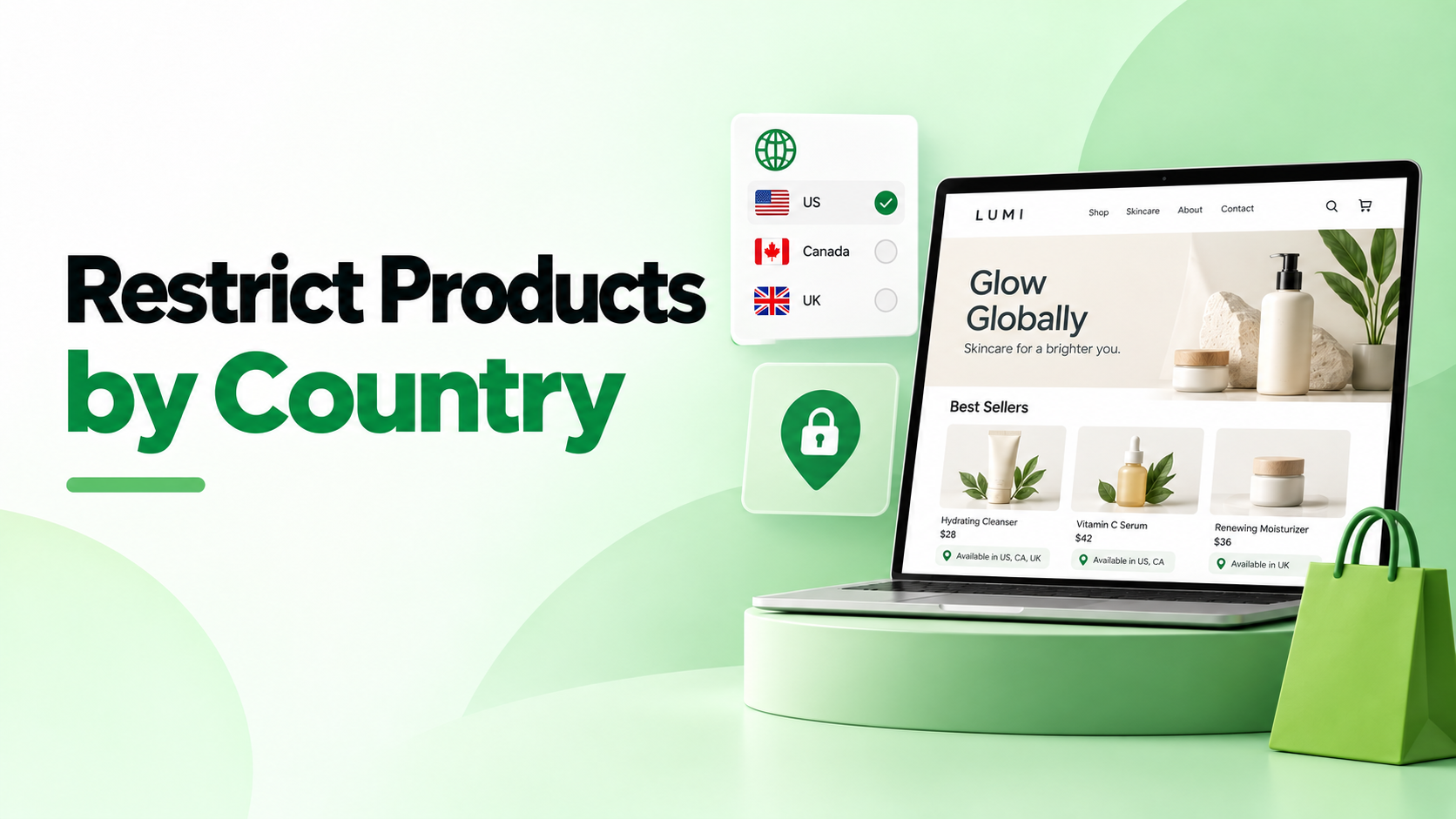
How to Restrict Products by Country on Shopify
Learn how to restrict Shopify products by country using Markets and storefront rules. Find out when to hide a product, price, or Add to Cart button, and what to test before customers shop.
Sep 22, 2026 · 6 min read
Best Shopify Themes in 2026: Free and Premium Options Compared
Your theme decides how fast your store loads and how much friction sits between interest and checkout. What separates a good theme from a pretty one, and a 20-minute test before you commit.
Sep 18, 2026 · 18 min read
Best Shopify Apps to Increase Sales in 2026: Complete Guide
The right apps recover sales you are already losing. The wrong ones slow your store and bill you monthly for something nobody uses. Which categories matter, and how to judge an app before installing it.
Sep 18, 2026 · 10 min read