
What Is Super Intelligence (SI)? AI vs SI vs ASI Explained
AI just got a new name, but your chatbot didn't get any smarter. Here's what "super intelligence" (SI) really means, how it differs from true superintelligence, and what it changes for your business.

Oct 1, 2026 · 12 min read
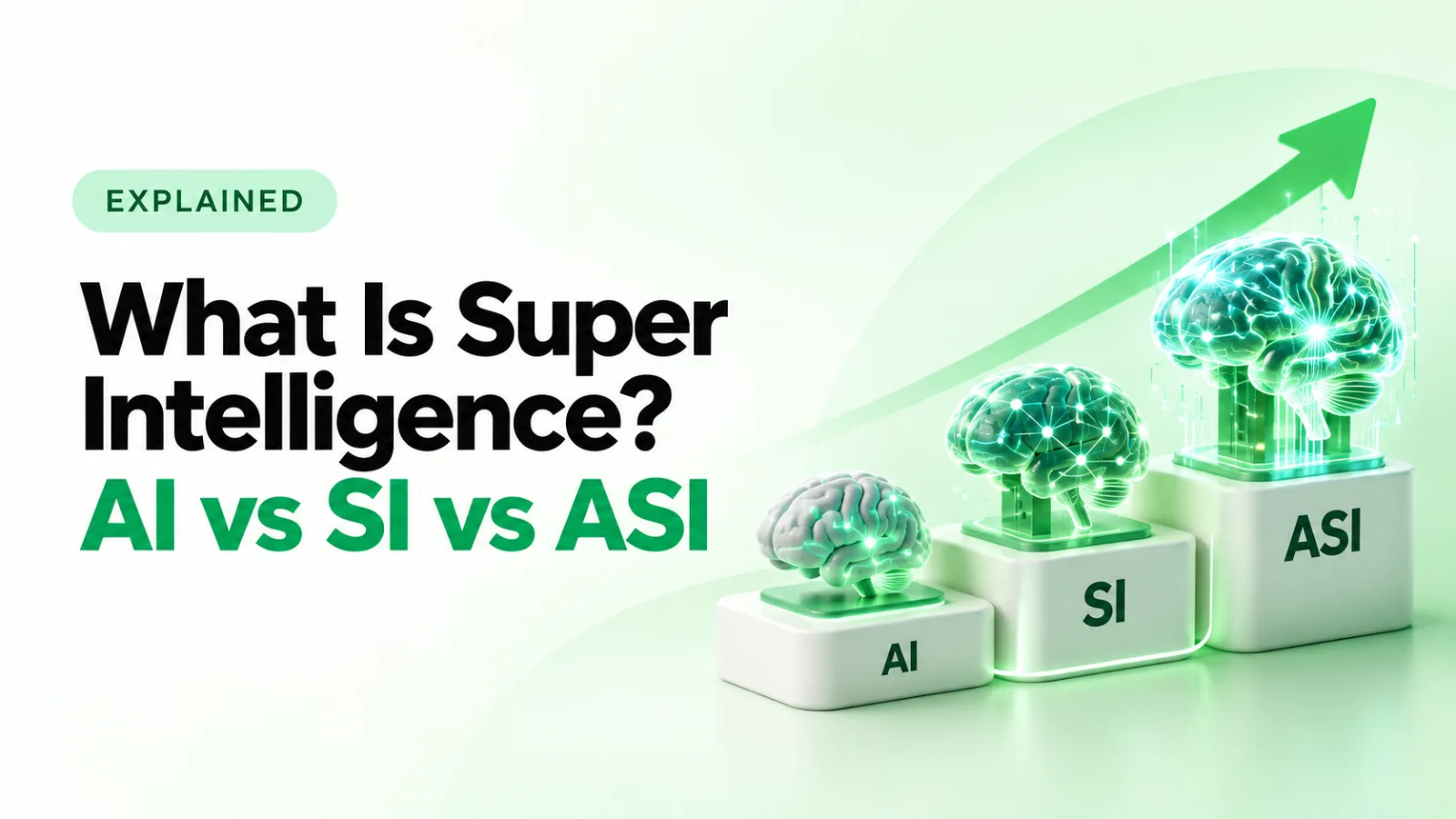
Quick answer: "Super intelligence" (SI) now has two meanings. Since September 22, 2026, it is the US government's official new name for artificial intelligence (AI), announced by President Trump at the UN. In AI research, superintelligence (ASI) has meant something much bigger for decades: a future AI far smarter than any human. Today's tools, like ChatGPT or Claude, are SI in name only. For businesses, nothing about your AI tools changed overnight, but the race behind the name is making automation better, fast.
A week ago, almost nobody said "SI." Now it is in government documents, news headlines, and your search bar. If you are confused about whether your chatbot just became a genius overnight, you are not alone.
This guide clears it up in plain English. No hype, no politics, just what you need to know as a business owner who uses AI every day.
In this guide, you'll learn:
Why AI was renamed "super intelligence" and what changed (and didn't)
The real difference between AI, AGI, SI, and ASI, in one table
Whether today's AI is actually super intelligent
The best arguments for and against the new name
Who is racing to build true superintelligence in 2026
What all of this means for your store, your workflows, and your marketing
Why everyone is suddenly talking about "SI"
On September 22, 2026, President Donald Trump used his UN General Assembly speech to rename artificial intelligence. He argued that the word "artificial" makes the technology sound fake, and said all US government documents would switch to "super intelligence," or SI. He also said he hoped other countries would follow. (Axios)
How it happened:
The week before: Trump ran polls on Truth Social asking followers to pick a new name. Options included superior intelligence, extreme intelligence, and supreme intelligence. (To Vima)
September 21: He started calling the technology "AI or SI" in a Truth Social post. (Tom's Guide)
September 22: He made it official at the UN, in the same speech where he rejected global efforts to regulate AI and framed the AI race with China as one the US must win. (AFP via ARY News)
What actually changed: the wording in US federal documents. What didn't: the technology itself, and the vocabulary used by the rest of the tech industry. A chatbot called "SI" today can do exactly what it could do when it was called "AI" last month.
AI vs AGI vs SI vs ASI: the simple breakdown
Here is the cheat sheet. Bookmark it, because these four terms will keep showing up in 2026.
Term | Stands for | What it means | Exists today? | Example |
|---|---|---|---|---|
AI | Artificial intelligence | Software that does tasks that normally need human thinking | Yes | ChatGPT, Claude, product recommendations, spam filters |
SI (new US usage) | Super intelligence | The US government's new name for AI. Same technology, new label | Yes, as a name | The same tools above, in federal documents |
AGI | Artificial general intelligence | AI that can match humans at most kinds of work and learn new tasks on its own | No, though frontier labs say they are getting closer | A reliable virtual employee you could hire for almost any desk job |
ASI (research meaning of superintelligence) | Artificial superintelligence | AI far smarter than the best humans in nearly every field | No, purely theoretical | An AI that makes scientific breakthroughs faster than whole research teams |
The one-line version: SI is a new name for today's AI. ASI is the AI of tomorrow that may or may not ever arrive. When you read "SI" in a government report, read it as "AI." (Solutions Review)
Is today's AI actually super intelligent?
No, not by the research definition. Today's AI is remarkable at specific things: writing, coding, summarizing, answering questions. But it still makes confident mistakes, needs human review, and can't reliably do a full job on its own.
A useful test comes from OpenAI's own definition of AGI: highly autonomous systems that beat humans at most economically valuable work. By that bar, today's AI isn't AGI yet, let alone superintelligence, because you can't yet hire it as a dependable virtual employee. (Defense One)
Try this quick reality check with any AI tool you use:
Question | Real superintelligence (in theory) | Today's AI ("SI") |
|---|---|---|
Can it run your whole business unsupervised? | Yes | No |
Does it ever invent facts? | Rarely, if ever | Yes, sometimes |
Can it improve its own design? | Yes | No |
Does it beat top experts in every field? | Yes | Only in some narrow tasks |
Do you still need to check its work? | No | Yes |
If you answered like the right-hand column, you are using today's AI, whatever it's called.
Is the rename a good idea? Both sides
The new name has strong supporters and sharp critics. Here are the best arguments on each side, so you can decide for yourself.
The case for "super intelligence"
AI isn't fake. Supporters say "artificial" makes a real, powerful technology sound cheap or unreal.
It matches the impact. AI products have spread faster than the internet or the iPhone, and the administration expects AI to become a major share of the economy. (Crowdfund Insider)
It signals ambition. Backers, including UN Ambassador Michael Waltz, see the name as a statement that the US intends to lead the global AI race.
The case against
The term was already taken. Superintelligence has had a precise research meaning for decades. University of Melbourne ethicist Simon Coghlan called the rebrand misleading for this reason. (To Vima)
It oversells today's tools. Computer scientist Kokil Jaidka noted the name borrows the prestige of a much bigger, still-unreached breakthrough.
It muddies risk discussions. If a government report warns about "super intelligence," readers can't tell whether it means ChatGPT today or a hypothetical future system. (Tom's Guide)
Some critics say the name is a distraction. A TechRadar columnist argued the bigger story is the administration's opposition to AI regulation. (TechRadar)
Will it stick? Too early to say. Federal documents will use SI, but most tech companies, researchers, and other governments still say AI. For now, expect to see both.
Real superintelligence (ASI): what it is and who is building it
Before the rename, "superintelligence" meant one thing: an AI much smarter than the best human brains in practically every field, including science, wisdom, and social skills. Oxford philosopher Nick Bostrom popularized the idea in his 2014 book Superintelligence.
The three types of superintelligence
Speed superintelligence: thinks like a human, but thousands of times faster. A year of expert work could happen in hours.
Collective superintelligence: many AI agents working together, coordinating better than any company or team.
Quality superintelligence: thinks in ways that are simply smarter, solving problems humans can't solve at any speed.
How could it arrive?
The most discussed path is an intelligence explosion. Once an AI is good enough to improve its own design, each better version could build an even better one. That loop could take AI from human-level to far beyond it quickly. Other researchers expect a slower climb, or say it may never happen. Nobody knows the timeline.
Who is racing to build it in 2026
The real superintelligence race is very real, and very expensive:
Lab | Founded | Approach | 2026 milestone |
|---|---|---|---|
2025 | Big-tech lab built through aggressive hiring | Released its first model, Muse Spark, in April 2026; Meta expects 2026 capex of $115B to $135B, up from $72.2B in 2025 (Reuters) | |
June 2024 | Co-founded by former OpenAI chief scientist Ilya Sutskever; plans to release nothing until safe superintelligence is ready | NVIDIA announced a partnership and investment in July 2026 (amount undisclosed) | |
Late 2025, London | AI that keeps improving itself instead of one big training run | Raised a $500M Series A at a $4B valuation in April 2026 |
Why experts worry
The central concern is the alignment problem: making sure a system far smarter than us actually pursues goals that are good for people. Bostrom has warned that an all-out race raises the risk of the technology getting out of control. (Defense One) Physicist Max Tegmark is campaigning to pause superintelligence development until it can be proven safe.
What SI means for your business and automations
Here is the part most news coverage skips. Whether you call it AI or SI, nothing about your tools changed overnight. But three things do matter for business owners right now.
1. Don't market your tools as "superintelligent"
It is tempting to ride the trend and call your chatbot or app "super intelligent." Be careful. Customers who expect genius-level answers and get ordinary mistakes will lose trust fast. Overstating what a product can do can also create legal risk under advertising rules in many countries.
Safer wording: "AI-powered," "AI-assisted," or simply describe the outcome: "answers order questions 24/7."
2. The real shift: from rule-based workflows to AI agents
Classic automation follows fixed rules: if a cart is abandoned, send email #1. AI agents can read context and decide what to do. In tools like n8n and Make, an agent can sort a support ticket, look up the customer's order, draft a reply, and escalate only the tricky cases to a human. We use the same idea when we automate a WordPress blog with n8n: AI writes the draft, and a person approves it before it goes live.
3. Every model upgrade flows into your stack
The billions going into the superintelligence race make the underlying models better every few months. If your workflows are built on a flexible platform, it improves when the model improves, often without a rebuild.
From our work: We see this shift in our own client projects. For Dexta, a pre-employment testing platform we designed and built, we integrated Google's Gemini AI to generate assessment questions automatically, alongside recruiter and candidate portals and real-time anti-cheating checks. The AI does the repetitive work; people stay in charge of hiring decisions.
What this looks like for an online business today:
AI support agents answering order-status and return questions around the clock
Product descriptions, SEO metadata, and AI-assisted blog posts that a human reviews before publishing
Inventory forecasts that predict demand before popular items sell out
Email and CRM flows that personalize offers based on each customer's behavior
6 steps to future-proof your automations
You can't control when (or if) true superintelligence arrives. You can build systems that get better with every AI upgrade instead of breaking.
Connect your tools first. Link your store, CRM, email platform, and helpdesk through APIs and webhooks. AI can only act on data it can reach.
Start with one high-impact workflow. Pick the task that eats the most hours, such as support replies or order updates, and automate it well before adding more.
Keep a human in the loop. Add approval steps for refunds, public content, and anything customer-facing. Loosen controls only once results prove reliable.
Choose model-flexible platforms. n8n and Make let you swap in a newer AI model without rebuilding the whole workflow.
Measure everything. Track hours saved, error rates, and revenue impact so you know which automations earn their place.
Protect customer data. Limit what each AI agent can see and do, and follow privacy rules in every market you sell to.
Pro tip: Write down a simple "AI policy" for your team: which tasks AI can do alone, which need approval, and which stay human-only. It takes 30 minutes and prevents most costly mistakes.
Conclusion: same AI, new name, real opportunity
"Super intelligence" is now the US government's name for AI, but the technology hasn't changed. True superintelligence, an AI far smarter than any human, is still a theory, even as Meta, SSI, and new labs pour billions into building it.
Key takeaways:
SI (new usage) = today's AI with a new label in US federal documents
ASI (research meaning) = a hypothetical future AI far beyond human intelligence
Today's AI is not AGI, and certainly not superintelligent
Avoid calling your own products "superintelligent"
The smart move now: connected systems, AI agents, and human oversight
Ready to put AI (or SI) to work in your business? At Pluginos, we build custom automations with n8n, Make, and AI agents for lead management, CRM sync, email, reporting, and store operations. Tell us what you want to automate.
FAQs about super intelligence (SI)
What does SI stand for?
SI stands for "super intelligence." Since September 2026, it is the US government's official term for artificial intelligence. In AI research, superintelligence (often ASI) refers to a hypothetical AI far smarter than humans.
Why did Trump rename AI to super intelligence?
He said the word "artificial" makes the technology sound fake, and that "super" is more accurate. He announced the change at the UN General Assembly on September 22, 2026, after polling followers on Truth Social.
Is SI the same as AI?
In the new US government usage, yes. SI is simply a new name for the same technology. It is not the same as artificial superintelligence (ASI), which doesn't exist yet.
What is the difference between SI and ASI?
SI (new usage) is a label for today's AI. ASI is a research concept for a future AI that would far exceed human intelligence in nearly every field.
Is ChatGPT super intelligent?
No. ChatGPT and similar tools are powerful but still make mistakes and need human checking. They may be called "SI" in government documents, but they are not superintelligent in the research sense.
Will other countries use the term SI?
Trump said he hopes so, but as of now most governments, researchers, and tech companies still say AI.
When will real superintelligence arrive?
Nobody knows. Predictions range from within this decade to never. Treat any confident date with caution.
How should my business respond?
Nothing about your tools changed, so focus on results: connect your systems, automate one high-impact workflow with an AI agent, keep human approval for important actions, and avoid marketing your products as "superintelligent."
Written by
Pluginos
Pluginos is a WordPress, WooCommerce, and Shopify development team with 8+ years of experience building plugins, apps, and eCommerce solutions. We share practical tutorials and insights based on hands-on development experience.
Related articles
Automate a WordPress Blog with n8n: Step-by-Step Guide (2026)
A complete step-by-step guide to automating your WordPress blog with n8n. Connect the REST API, generate AI drafts, add featured images, and review before you publish.
Sep 30, 2026 · 19 min read
WordPress Blog Automation With AI: 6 Ways to Create, Review, and Publish Posts
Automate your WordPress blog with AI using six practical methods, from the editor and plugins to n8n and Zapier. Learn how to create drafts, review content, and publish with confidence.
Sep 28, 2026 · 13 min read